
Korea’s Geopolitical Importance in the Late 19th Century
written by Theo Pallesen
In the late 1800s, ruling King Gojong of Korea faced major decisions and concerns in order to secure the future and independence of his country. Korea (formerly known as Joseon) was under pressure and even threatened by surrounding major powers.
China, Japan, Russia, and even the United States were seeking influence and power on the Korean Peninsula. A key reason for this was Korea’s strategic location in the geopolitical landscape of East Asia.
Korea’s Strategic Location
An old Korean saying describes the country as: “A shrimp gets crushed to death in the fight between whales.” This metaphor illustrates how Korea has often been perceived as smaller and less powerful than the major powers surrounding the peninsula. With enough imagination, the shape of the Korean Peninsula could even resemble a shrimp.
Throughout the history of East Asian power dynamics, Korea has often been less influential than its large neighbors, China and Japan. However, this does not mean that Korea was an unimportant piece in the geopolitical puzzle. On the contrary, Korea has often been an attractive territory for larger powers to influence or control, particularly during the transition from the nineteenth to the twentieth century.
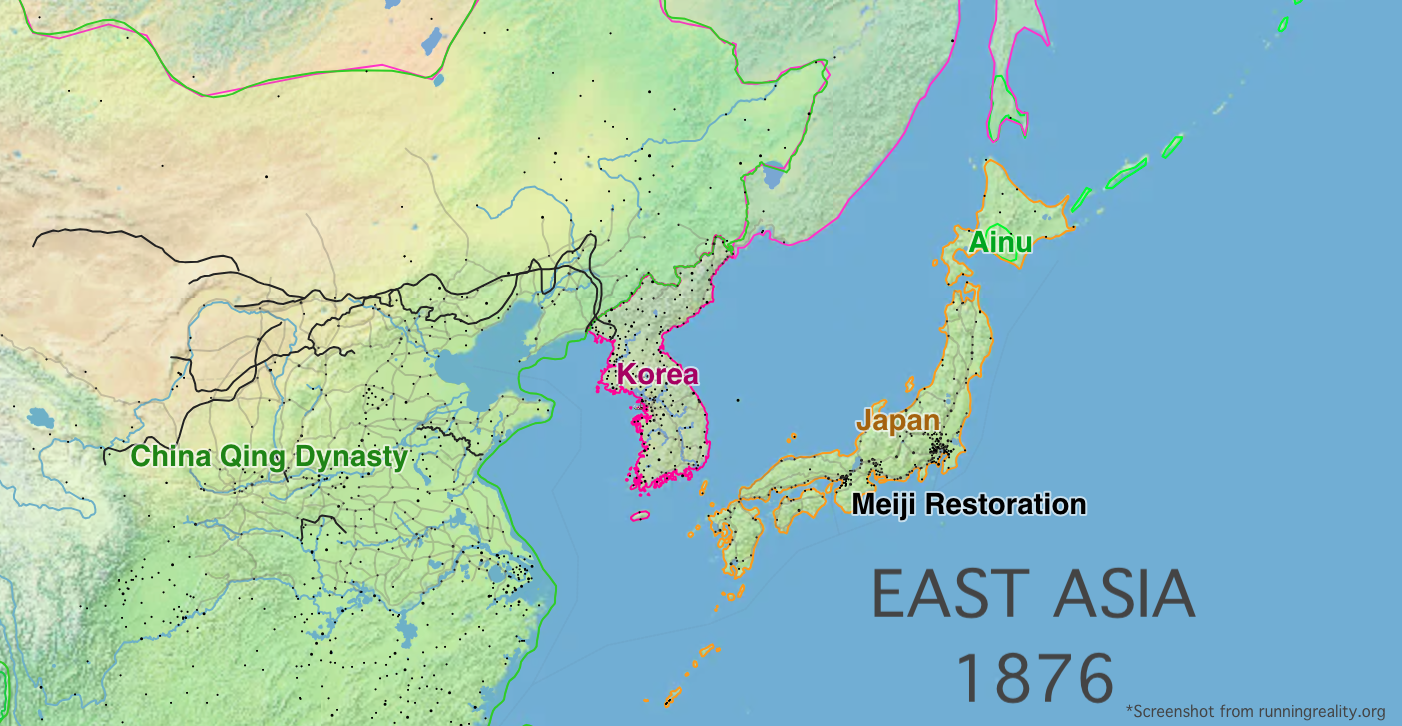
Korea occupies an important geographic position between China, Japan, and Russia. The peninsula also borders important bodies of water, including the Yellow Sea, the East Sea, and the Korea Strait.
Because of this location, many major powers recognized the strategic potential of Korea. Control over the peninsula could allow influence over military movement and trade routes in Northeast Asia. In this sense, Korea could function either as a defensive buffer or as a potential military staging ground.
Competing Powers’ Different Interests
The competition for influence in Korea mainly involved China, Japan, Russia, and the United States.
China had historically maintained a tributary relationship with Korea and viewed the peninsula as part of its traditional sphere of influence. From the Chinese perspective, Korea could serve as a buffer state that helped protect northern China from potential foreign threats.
For Japan, Korea was seen as strategically crucial for national security. Japanese leaders feared that if another major power gained control over the peninsula, it could threaten Japan directly. As a result, Japan increasingly sought political and military influence in Korea during the late nineteenth century.
Russia also showed growing interest in Korea as it expanded its influence in East Asia. Russia sought greater access to the Pacific and viewed Korea as a potential location for strategic ports and regional influence.
The United States, on the other hand, was primarily interested in establishing diplomatic relations and trade opportunities. By forming agreements with Korea, the United States hoped to strengthen its commercial presence in East Asia.
King Gojong’s Diplomatic Strategy
During this period, Gojong of Korea ruled Joseon while facing increasing pressure from surrounding powers seeking influence over Korea. In response, he attempted to pursue a diplomatic strategy that balanced relationships with multiple countries.
Rather than aligning Korea completely with one major power, Gojong sought to establish diplomatic relations with several nations, including the United States. By doing so, he hoped to maintain Korea’s independence and prevent any single power from dominating the peninsula.
